We had the good folks from Storycenter back for a workshop. Given everything that’s going on, we took it as an opportunity to process, to think about how we’ve been getting through this time.
This video was my answer.
We had the good folks from Storycenter back for a workshop. Given everything that’s going on, we took it as an opportunity to process, to think about how we’ve been getting through this time.
This video was my answer.
I’ve been amused by the #15secondshakespeare phenomenon, so I was pretty stoked when it showed up as a daily create. I actually thought I was going to do a different old standard… but then, in honor of making another trip around the sun, I picked this one. Honestly, I’m kind of hoping it’ll go viral. Surprise your friends with it.
The music is “Go From My Window“, a 16th century folk song as arranged by John Dowland and performed by Frank Hiemenz, under a CC-BY license. (It’s really quite pretty when I’m not over-acting over it.) I dumped it into GarageBand and recorded my voice in another track. Lining up my voice at the end of the first phrase was a pretty clear choice; I had to fade the guitar down (further than I thought I’d need to) and adjust the spoken volume up a bit.

It’s 10 years since Katrina and Rita and the levees broke. If you haven’t read Lolis Eric Elie’s magnificent piece “The Whys” on The Bitter Southerner you really ought to. It resonates with my own meager experience rebuilding in New Orleans for a week, in that every person I met had a story to tell about their flood experience, about their rebuilding decisions.
No, that’s not right – not just a story to tell. A story to share, a story to ask us to carry. An invitation to help them process, as they made decisions about possessions, and places. Maybe a request to be remembered as an individual, not as a statistic in a historical episode.
That is part of the point of storytelling, in any form. Memoir, fiction, nonfiction, mashup – we try to make a connection, form a bond, refute entropy. We make stories, and make sense; in telling or listening, we expand ourselves.
And maybe that’s the context which explains why I took a recent post by Alan Levine to heart.
I really cannot tell much about you as a person from your long scroll stream of context-less reblogged media created by other people
— Alan Levine (@cogdog) August 25, 2015
The Stream is a funny thing. A friend sharing pain, a cat video, an echo from the political chamber, a friend announcing joy. When the same information feed serves as my newspaper, my editorial magazine, my entertainment, and my connection to my friends, it’s hard to remember to treasure those acts of deep sharing.
So, I guess, we beat on, boats against the tide. We smash the Like button, we write “hooray” or “I’m sorry” or “I’m with you.” We retweet and reshare, and we hope it’s enough to make the world a safe space for stories. Sometimes we open an email or pick up the phone. Or we write a letter to the papers or the government and we give money and we vote. And sometimes, we open a word processor or blog post or image or video or audio editor and make art, dammit.
All because we hold you in our hearts. Because we listened, and we grew, and we bonded, and we remember.
“open, yes we’re open” by Derek Bridges, CC-BY 2.0 at https://flic.kr/p/8d67SR
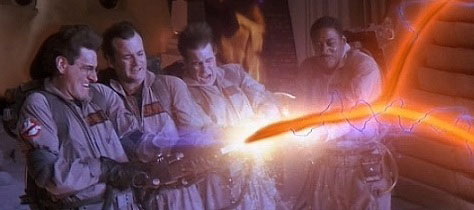
Still from Ghostbusters, from https://ageofsteam.files.wordpress.com/2013/01/crossing-the-streams.jpg
I had the distinct pleasure last week of hosting Joe Lambert and Brooke Hessler from the Center for Digital Storytelling for a workshop at Kenyon. I believed that I was going in as the on-site tech support guy, so I didn’t think I was going to make a story. See, I was going to be helpful to other people, and watch Joe and Brooke to really learn how to facilitate a story circle.
Concetta (who had been in our 2012 workshop), said that was sad, because I’m a good storyteller. (Which is not, to be honest, something I’d gone into this workshop considering.) And there was a ripple of agreement in the room, that my colleagues wanted me with them as a participant. And Joe said “no free riders.”
So I started wracking my brain for a story to tell.
The penny dropped when, during another person’s turn in the story circle, Joe pointed out that writing a letter to someone can be a great storytelling prompt. I started thinking about people I’d like to talk to, people I might owe a thank-you note or an explanation.
I remembered that I have a story which recently eluded telling.
And here’s another way to tell it.
From a storytelling perspective, shifting the audience made all the difference in the world. By making it a piece for Melanie, instead of for “the world”, clarifying an in-joke became sharing an anecdote. And technically, relating the story out loud, and getting feedback from a room of supportive colleagues, helped me find a lot of the connective tissue which I didn’t find alone with my keyboard.
So thank you, my Kenyon and CDS colleagues (and my wife, who saw a rough cut), for sharing your courage, for your aesthetic input, and for sharing this story with me.
I already drew a map which tells a story, so when TDC 1237 challenged us to make a map which explains nothing, it seemed like a fitting challenge. I was inspired by the map of “Super Bowl Wins By Country” on the TDC page, so here’s:
(Edit: this used to be an interactive map. But Google killed the product. So here’s a screenshot.)
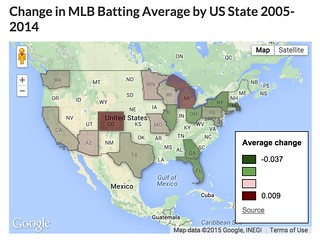
This map is made with Google Fusion Tables. The team batting average data comes from Baseball-Reference.com; the state shapes are a resource file within Fusion Tables. (This introduces the one unintentional inaccuracy in the map – I couldn’t quickly find a shape file including both U.S. states and Canadian provinces, so the Toronto Blue Jays are just left off the map.)
More importantly, its story is a mess. For starters, who would compare team batting average over 10 years? There are so many differences in lineups and managers (and probably even park effects) that it seems like a pointless comparison. (My baseball geek friends are welcomed to debate that point.)
“Batting average by state” is almost as meaningless as “Super Bowls by country” – maybe more so, because it suggests specificity. But if there’s a useful reason to compare the average batting average of the 5 teams in California with the 1 in Maryland, I’m at a loss to explain it. (And you can barely see the poor Nats in DC.)
The state statistics are actually an average of team batting averages in the state, but every team doesn’t have the same number of at bats, so that introduces a little inaccuracy. Not much, but it would show up out at the 4th digit.
And then there’s design. Google only labels the top and bottom of the legend, so we know the bounds, but not what the middle colors correspond to. I picked a green color for half the scale, on a map which is mostly green – very bad for readability, especially in the Satellite view. I also set green to correspond to the biggest declines, and red for the biggest increases, which I think is the opposite of American expectations.
But I did learn a little about Fusion Tables, and practiced normalizing data, so that was fun!
TDC 1222 asks us to write a list of our regrets, and video ourselves throwing it away.
I did it my way.
(Kids, ask your parents. Or possibly your grandparents.)
As you can tell from the watermark, I used WeVideo to make this. We’ll be using it next week at a workshop run by the Center for Digital Storytelling, and I’m the local tech support, so I thought I better try it out. It’s a web-based video editor, with a clean interface; I can see why it might work well as an intro tool for new video editors and in community outreach situations.
Also, it can import video from a USB webcam, which apparently iMovie can’t. This shot comes from my Logitech webcam, perched upside-down on top of my monitor. (That simultaneously solved the problem of how I can film my own hands, and how I could get the writing right-side-up.) My hands aren’t quite in frame enough at the end, but it got the concept.
The silence at the beginning is a little disorienting; if I were going to work more on it I’d try to capture the sound of pen on paper or maybe add a soundtrack. Let’s file that under “lessons learned”, and certainly not under “regrets!”
Daily Create 1180 asked us to create a soundmap of our town. Instead of following the prompt as written, I picked one moment in my day – walking home in the early afternoon from a Krudas Cubensi concert at Kenyon College.
It was early April – the trees were starting to bud, and you can hear a light spring breeze blowing through the microphone at places. The birds have returned, and you can hear them chattering at each other. But it’s too early for the hum of lawnmowers, not warm enough yet for the drone of air conditioners. Gambier is a rural town; I think in the 6 minute walk you’ll hear 3 cars go by.
You’ll also hear my feet. Boy, will you hear my feet. I really thought I was holding my iPhone high enough to not get so much of that noise, but apparently not. So, there’s an excuse to learn something new – I opened up the graphic equalizer in GarageBand, turned on the analyzer so I could see where the frequencies of my footfalls lay, and turned those ranges down. They’re still prominent – it is a walk, after all – but I don’t think they’re as dominant as they were in the original.
This is my walk to work. I’ve probably taken it more than 4,000 times. But I usually take it with my headphones on and music or a podcast going, so I miss these sounds – which means I miss the chance to contemplate the seasons and the neighborhood. I appreciate TDC reminding me that there is value in taking a walk just to listen.
We knew the previous owner of our house was an accomplished gardener, and all summer and fall we enjoyed the fruits of his labor – redbuds and crabapple trees, hostas and yucca flowers. But we’d chosen the house in May, and so we had no idea in our first April that the grove of walnut trees was about to explode into a field of daffodils.

Every year, the daffodils return – even as the trees along the driveway have started to crowd each other, even through the many years when the magnolias only have browned and wilted frostbitten flowers, even when the squirrels eat our crocus bulbs and the deer decimate the hostas. Every year, at least for a moment, they surprise and encourage me.
Today was that day.

It’s also a day when I can celebrate the fact that I’m making a little progress as an iPhone photographer, and more as a photo editor. The preset Flickr filters completely let me down on this photoset, and I had no hesitation about fiddling with the sliders myself. The first photo, for example, is unretouched, but on the second one, I added just a bit of saturation to the colors. My goal was to get the yellow centers of the daffodils to pop a little; notice how it also makes the grass translucent, and even makes the downed wood in the back show up better.
(I’m not lazy, I’m grasscycling.)
I also used editing to save a couple shots. This isn’t a bad picture – I like the way the flowers stretch to the background, but the one which fell over messes up the line, and the garage of the neighbors’ damned McMansion is incongruous in the background.

My wife pointed out that it’s really a photo of the two closest daffodils… so I cropped it down until that’s what it was. (I really like the way the Apiary/Flickr photo editor is designed to remind you of the rule of thirds.) A little tweak of the contrast setting and voila:

On the next one, I actually quite like the way I got close-up on the flowers, with the vertical lines of the not-quite-awake trees against the sky. But there’s that damned garage again.

I had hoped the Focus tool would make the garage go away; it didn’t, and it became a photo about how I found the Focus tool. So back to the crop tool I went. I had to lose a little bit of the trees, because the vertical impact was too strong in the narrower photo, but on the whole I’m pleased.

I suppose the next lesson is to see these photobombs while shooting instead of fixing them in post, but it’s nice to have a growing sense of what’s fixable.
Happy Spring to you and yours!
I used to piss and moan about the cold. I took winter personally, as if the creeping cold and damp grey skies were a direct affront, some rude gesture designed to put me in my place.
The winters of the last few years have disabused me of that notion. Something about 0 Fahrenheit, about -10 Fahrenheit, hit a reset button. Obviously this was not a force which cared a whit for my little existence. This was something monumental; a simple, brutal, elemental force to be endured.
I also know that the last snowfall in this area can be as late as April 15th, but I let nature fake me out with a week of very pleasant temperatures. Yeah, that one felt personal.
So I let it shake a mashup loose, which I’d imagined some time ago. I’m actually surprised I couldn’t find it already in existence:

The background is an HBO wallpaper of the Iron Throne, and the tag line is the motto of House Stark. (I thought about using a picture of Sean Bean, but let’s be honest, it’s been done.)
The little mouse is Leo Lionni’s Frederick. Frederick is a twist on the tale of the ant and the grasshopper – while the other mice industriously harvest food for the winter, Frederick sits about and “harvests” the senses and stories of summer and fall. When the dark and cold comes, the mice have laid up enough food to go on… and Frederick has kept enough memories to give them a reason.
Technically, this was a nice easy combo to work with – Lionni’s pages are simple, so I just selected all the white in the image and made it transparent. (And then I got to paint the whites of Frederick’s eyes back in.) I wish perhaps I’d spent a little more time cleaning up the edges, but the lighting in the HBO shot is weird enough already (coming from both in front of and behind the throne) that a little highlighting around the mouse and flower isn’t too offensive.
Artistically, I like the juxtaposition of gentle Frederick and the violent Iron Throne. Winter can make us mean. Our bodies even respond to cold by hunching in on ourselves. It’s a time which rewards hoarding and holing up… maybe that’s why Americans put our major food-sharing and gift-giving holidays in it. Frederick responds to this instinct to hoard by preparing to give of himself – his memories, his sensations, his art – because he knows his community will need that too, and he knows no one else is preparing for it.
So make art, dammit.

I bought myself an Intuos tablet some time ago at work, on the grounds that I would use it for Big Serious Stuff like annotating screenshots or making screencapture videos. In theory, drawing with a mouse is hard and a pen interface should be easier. In practice, a tablet input is neither like a mouse or a pen (or a touchscreen) and it can be frustrating to get started.
And there it sat, gathering dust, taunting me to read the manual, pick software, practice, prove myself worthy.
Now might be a good time to point out that I describe my drawing talents as “maxed out at stick men.” So when it said I wasn’t worthy, I assumed it was right.
I brought it home a while back, thinking big thoughts about how I’d use it to think about the shape of stories, especially as they relate to the stories we tell when we do technology trainings. Sitting on the dining room table, it caught my son’s eye.
“Daddy, what’s that?”
“Oh, it’s for drawing on the computer.”
“Can I try?”
“I guess so… but I have to plug it in and find the software and all that.”
“OK. Well, can we do that?”
“Um… yeah. Yeah OK. Let me see.”
It’s hard to enter the Kingdom of Technology like a little child, after I’ve debugged and disinfected and documented professionally for so long. It’s a challenge to ask “why not?” But I got the drivers installed, and after dorking around looking for the “right” software, I figured out that Microsoft Paint would work as well as anything for letting my kid play.
And it wasn’t simple, his learning to match up the pen to the screen. After a bit, he got it and started exploring Paint. An arrow became a house. Green squiggles became grass. A line was the horizon; the fill tool gave him purple grass and a yellow sky.
And he said it was my turn.
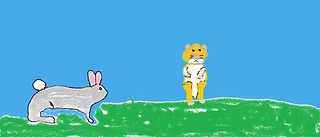
How about a bunny? I think I can draw a bunny. (It’s like a dog with no neck and bunny ears, right?) Hey, maybe the spraypaint brush will make the fur look more furry. A bunny should be on grass. OK, painting that grass was kind of annoying, what if we do the sky with a fill tool?
Draw your stuffed hamster? Sure, why not. I can draw Hamster.
Oh, the hamster’s name is Rhino? Of course it is. I’ll draw Rhino.
Objectively, I know it’s … primitive. But the fact is, I made it, and making it was fun. And I pretty much killed the excuse that learning how to use the tablet would be too hard.
I’ve tried to get multiple faculty members to try out these tablets, and few of them are willing to put in the work. I wonder if the problem is that I haven’t asked them to just draw a happy little tree.
